 Initial Pool Offering$IPO
Documentation
Everything behind the joke: where the name came from, what the contract actually does with a fee, how a distribution reaches your wallet, and what can go wrong.
Where the name comes from
On 7 September 2020, Changpeng Zhao tweeted that Binance was doing an IPO — then landed the punchline: Initial Pool Offering. A joke about liquidity pools, not public markets. It has been a running gag in crypto ever since.
This project takes that name at face value. Initial Pool Offering is not a riff on the tweet — it is the tweet, deployed. CZ supplied the joke; the contract supplies the mechanics, which is what the rest of this page documents.
This project is not affiliated with Binance or with CZ, is not endorsed by either, and is not a securities offering. Holding $IPO gives you no equity, no dividend entitlement in the legal sense, and no claim on any company.
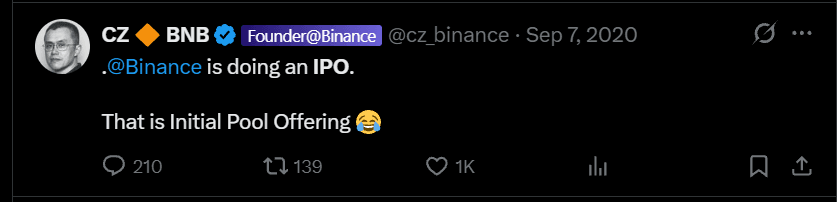
He named it. We built it.
The idea
A token with a trading fee has to answer one question: where does the fee go? Most answers are some version of the treasury, which is a wallet somebody controls. $IPO answers it with a contract path you can trace — the fee buys a reward asset, and the reward asset is credited to holders by balance.
That turns holding into the only action the token asks of you. There is no farm to enter, no position to manage, and no second contract to approve. Your balance is your position.
The numbers
- Ticker
- $IPO
- Chain
- BNB Smart Chain (id 56)
- Contract type
- DividendToken, Solidity 0.8.7, MIT
- Buy fee
- 10 / 1000 (1.0%)
- Sell fee
- 10 / 1000 (1.0%)
- Transfer fee
- 0 / 1000 (none)
- Contract
- 0x1C6cDA75Eb11eF73AF54A5bdFBeACc53e934632b
- Reward token
- 0xbe9D156892E55e7154BcD3cB0FEA677F9D3103E1
- Router
- 0x10ED43C718714eb63d5aA57B78B54704E256024E
On-chain name and symbol may still read the deployment label used at launch. The site brands the project as Initial Pool Offering regardless; the address above is the one that matters.
How a distribution reaches you
$IPO uses the standard dividend accounting model. Rather than sending tokens to thousands of wallets — which no contract can afford — it tracks one number and lets each holder derive their share from it.
- Trades against the liquidity pair collect a fee, denominated in $IPO, into the contract.
- Once the collected balance clears the swap threshold, the contract sells it through PancakeSwap for the reward token.
- The proceeds raise
magnifiedDividendPerShare, a single global figure. Every eligible holder's unpaid balance rises against it, in proportion to what they hold. - You call
claimDividend()to withdraw. Until then the balance simply accrues — check it withgetUnpaidEarnings(address), or by connecting a wallet on this site.
Eligibility is gated by minHoldForDividend. Wallets below that threshold, and addresses explicitly excluded, do not accrue. Liquidity pairs and system addresses are normally excluded so distributions concentrate on real holders instead of the pool.
What holding actually does
There is no lockup and no staking contract. $IPO sits in a wallet you control, and your claim on each distribution tracks your balance at the time it happens. Buy more and your share of every future distribution grows. Sell and it shrinks. Drop below minHoldForDividend and you stop accruing until you are back above it.
Rewards already credited to you stay credited. Selling does not claw back an unpaid balance you earned while holding.
Connecting a wallet
The wallet button on this site is read-only. It calls two view functions — your balance and your unpaid rewards — and nothing else.
This site will never ask you to approve a token, grant an allowance, or sign a transaction. If a wallet popup asks for spending permission while you are here, reject it. That request did not come from anything on this page.
Claiming happens on the contract itself, through BscScan's write interface or any wallet that can call claimDividend(). Nothing on this site can move your funds.
What happens next
- Launch and verify. Contract deployed and verified, Proof of Contract published, trading opened.
- Widen the reward basket. Route fee proceeds across a set of tokenized stock exposures rather than a single reward asset, and document each addition before it goes live.
- Open the books. The Explorer already reads
SwapAndDividendandDividendClaimedevents. Next is per-wallet claim history and cumulative distribution totals. - Community rails. Social channels, holder tooling, and a distribution schedule once the holder base justifies it.
Questions people actually ask
Is this connected to Binance?
No. The name riffs on something CZ said. There is no partnership, endorsement, or affiliation of any kind.
Do I have to stake?
No. Hold $IPO above minHoldForDividend in a wallet you control. That is the entire mechanism.
Am I buying actual shares?
No. The contract buys a reward token that represents on-chain stock exposure. You receive that token, not equity, and not any right attached to equity.
When do distributions happen?
Whenever collected fees clear the swap threshold. Busy trading means frequent distributions; quiet trading means fewer. There is no fixed schedule.
Can the fees be changed?
Yes, by the contract owner, up to a hard ceiling written into the contract. Read buyFee, sellFee, and transferFee on-chain rather than trusting any figure printed on a website — including this one.
Why is my unpaid balance zero?
Either no distribution has happened since you bought, or your balance sits below the minimum hold. Both are readable on-chain.
Risks
$IPO is an experimental meme token. Read this section as the part that is not a joke.
- Contract risk. Verified source is not the same as audited source. Bugs in this contract, in PancakeSwap, or in the reward token can lose funds.
- Owner risk. Fee rates and exclusions are owner-controlled within the contract's limits. That is a trust assumption you are taking on.
- Reward asset risk. Tokenized stock products carry market risk, oracle risk, redemption risk, and regulatory risk that a normal broker account does not.
- Liquidity risk. A thin pool means the price you see is not the price you get, in either direction.
- Total loss is a realistic outcome. Nothing here is financial, legal, or tax advice. Do your own research and size accordingly.